
Before we start the Winsor & Newton Dammar Varnish Tutorial:
When to Varnish: Never apply final varnish to an oil painting unless thoroughly dried. Oil painting requires anywhere from 6 to 12 months (or longer) to dry, depending on the thickness of the paint. If you want to add a temporary finish to paintings that have not dried thoroughly, you should consider using a retouch varnish.
When Not to Varnish: If you have large sunken, i.e., dull and flat, areas on your original unvarnished oil painting, consider oiling out the painting before applying a final varnish. Varnishing will even out the finish on paintings that are reasonably even already, but if you have areas that are high gloss along with sunken sites “due to variations in the types of pigments and mediums used” [1], then applying a final varnish may not even out the finish as you might be expecting. Oiling out is suggested in such a case. If you decide to oil out your painting, you will need to wait an additional six months before applying your final varnish, and it’s best to perform the oiling out process shortly after completing your painting within the first few weeks.
In this tutorial, we will accomplish the following:
- Learn a method for applying multiple thin coats of varnish.
- Learn a brushing technique that will minimize uneven brush strokes that could be visible in the final product.
- Achieve a high gloss finish similar to many paintings in museums, sometimes called a museum finish.
Additional points to remember when varnishing:
Use Good Ventilation: You will notice in the images used throughout this tutorial that I am working next to a window and using a fan to keep the air moving. Varnishing per this tutorial can take one to two days, so ensure your work area is adequately ventilated to prevent fumes from building up.
Brush Selection: The largest painting varnished in this tutorial is 12″x16″, and the smallest is 4″x6″. I chose a fine bristled brush that is 1″ wide. For paintings larger than 12″x16″, you should use a brush with a width in the 1-1/2″ to 3″ range. Only be cheap when purchasing a varnishing brush if you want to pick bristles from your varnish. Also, once you use a brush for varnishing, DO NOT use it for painting; if you have a brush you previously used for painting, DO NOT use it for varnishing. Purchase a varnishing brush that will only be used for this purpose.
Winsor & Newton Dammar Varnish: “You will need some Dammar varnish thinned 50% with turpentine. Turpenoid or mineral spirits will not dissolve the Dammar; it must be real turpentine.” [1] I used Winsor & Newton Dammar Varnish for this tutorial, which comes pre-thinned (50% Dammar / 50% genuine turpentine). It is ready to be applied from the jar without further thinning. DO NOT shake your jar of Dammar because this could cause air bubbles to form in the varnish, which you want to avoid.
We are ready to start this Winsor & Newton Dammar Varnish Tutorial by John O’Keefe Jr. & Kate (Nelson) O’Keefe.
Step-By-Step – Winsor & Newton Dammar Varnish Tutorial
Step 1
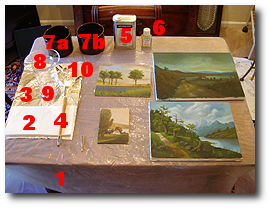
Assemble all materials and tools before starting.
- 1. Plastic Sheet
- 2. Paper Towel
- 3. Aluminum Foil Sheet
- 4. Varnishing Brush
- 5. Pure Turpentine
- 6. Dammar Varnish (Winsor & Newton)
- 7a. Ceramic Bowl (#1)
- 7b. Ceramic Bowl (#2)
- 8. Glass Pot for Dammar Varnish
- 9. Glass Container for brush cleaner
- 10. Tweezers
- 11. Unvarnished Painting(s)
- 12. Small Funnel (not shown)
Step 2
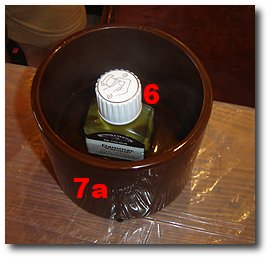
Heat some water until almost boiling, and pour some hot water into the first ceramic bowl (item 7a).
“Be careful not to scald yourself with the hot water.”
Fill the ceramic bowl with enough water that the jar of Dammar Varnish (item 6) sits primarily submerged. Let the Dammar warm for about 5-10 minutes. Warming the Dammar will lower its viscosity without adding more turpentine, making applying easier. I recommend using a ceramic bowl because of the heat-retaining properties of ceramic – you want to keep the Dammar warm until you have finished applying a thin coat of varnish to your painting(s).
I have seen another tutorial using Winsor & Newton Dammar Varnish where the warming process I described was not used. In that tutorial, the Dammar was poured directly into a pot (without warming) and applied directly onto the canvas with a brush. The warming procedure I describe in this tutorial seems relatively common in other varnishing tutorials. With that said, some words of caution: “Varnish is highly flammable, so DO NOT use electric heating/warming devices while using varnish!” [1] The hot water method seems to be a widely accepted and safe alternative.
Step 3
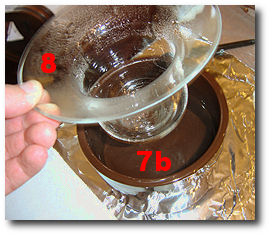
Before removing the jar of Dammar warming in the first ceramic bowl, pour fresh hot water (not boiling) into the second ceramic bowl. (item 7b)
“Be careful not to scald yourself with the hot water.”
Insert the glass pot (item 8) into the ceramic bowl with the hot water, ensuring that the glass pot is sufficiently submerged under the water.
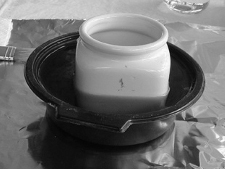
You can use a different style container than I am using as long as the pot fits into the warming bowl without displacing too much hot water and has a large mouth to accept your varnishing brush. (See reference photo below that shows another artists setup)
Step 4
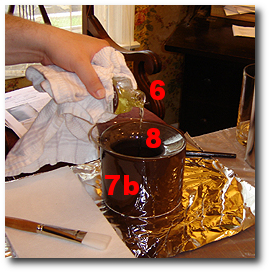
Pour some of the warmed Dammar Varnish from the jar (item 6) into the glass pot (item 8) that is sitting in the warming bowl (item 7b):
“Notice I am holding the jar of Dammar with a cloth rag. Remember, the jar has been sitting in hot water.”
I used a 75ml Winsor & Newton Dammar Varnish jar and poured approximately 37ml into the glass pot. Generally, have at least 1/2″ of varnish in your pot. “Every time I add more varnish to the pot, I also change the hot water that the jar warms in (step 2) and the hot water that the pot sits in (step 3) to maintain the varnish temperature.” [1]
Step 5

Dip your brush (item 4) into the heated Dammar and lightly wipe each side of the loaded brush against the side of the glass pot (item 8) to remove excess Dammar:
If you begin brushing with an overloaded brush, you might develop a puddle of varnish on your canvas, and your coating will likely be too thick. On the other hand, if you remove too much varnish from the brush, you will not get enough coverage, and your brush will run dry before you can make one pass across the canvas.
Step 6
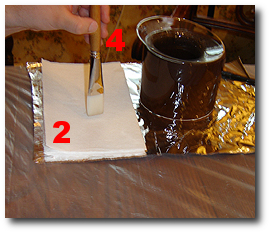
Using the paper towel (item 2), touch the tips of the bristles to remove excess Dammar from the tip of the brush (item 4):
You might think that removing all this excess Dammar from the brush will leave us with too little varnish to cover the canvas. Our goal in steps 5 and 6 is to remove excess varnish, prevent puddling on the canvas, and prevent applying too thick of a varnish coating at once. At the same time, we want enough varnish in the brush so that we do not run dry halfway across the canvas as we move the brush from one side of the painting to the other. The technique we are trying to develop in this tutorial is the application of multiple thin coats of varnish.
With practice, you will learn how much excess Dammar to remove from your brush to prevent either of these situations.
Step 7
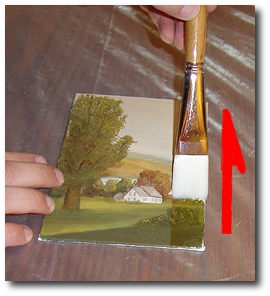
Before we start applying varnish, let me explain the process briefly. We will apply varnish first in columns (along with the vertical axis of the painting) and then in rows (along with the horizontal axis of the image). We will brush on the varnish one column at a time, first in one direction, then back over the same brush stroke in the opposite direction. Once we cover the entire painting this way, column by column, reloading the brush with each back-and-forth pass, we will rotate the painting 90 degrees and repeat the brush strokes in the same back-and-forth pattern along the horizontal axis, row by row, but this time without reloading the brush with fresh varnish after each pass.
I have listed Winsor & Newton’s recommended application method for their Dammar Varnish: [2]
- Apply the varnish in 1-3 thin coats rather than one thick coat. A thick coating will take longer to dry, may dry cloudy, drip, or sag during the application, and has a greater chance of showing brush strokes when dry.
- Thinned varnish is more susceptible to producing bubbles. Refrain from being vigorous in your application.
- Apply long, even strokes to cover the surface from top to bottom while moving from one side to the other. While working, inspect the varnish layer at all angles for bubbles. Even them out immediately.
- Once you leave an area, stay within areas that you have done. If you do, you risk dragging partially dry resin into wet, which will dry cloudy over dark colors. Allow drying completely before doing any revarnishing.
Starting at one of the corners of your canvas, place your brush into position and in one long brush stroke across the painting. Make one long, even brush stroke from one side to the other side, and then leave it alone. Do not stop part way through. Do not return to touch up a spot you feel could be better unless you see a drastic problem, like large areas of no varnish or bubbles.
Reminder: Even though we have warmed the Dammar, we need to work quickly because once applied to the canvas, the Dammar will begin setting immediately. After about 10 minutes, the varnish will be tack dry.
Step 8
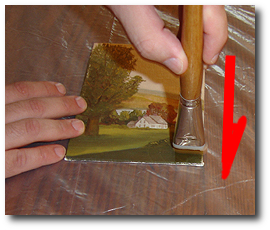
After reloading the brush, make another long stroke in the opposite direction, directly over your first brush stroke. As we did with the first brush stroke, move the brush in one long, even stroke from one side to the other. (Note: I always apply my first strokes along the vertical plane when varnishing landscape. When I rotate the canvas to pass over the first varnish coating, I move the brush along the horizontal plane.)
Step 9
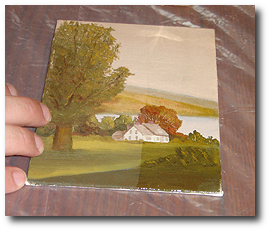
Make a brief scan of your progress after each back-and-forth pass of the brush to ensure you’re getting even coverage. If you see large uncovered areas as you move across the painting, you probably removed too much varnish from the brush during steps 5 and 6.
However, if everything is going well, you should start seeing the difference the varnish has in the oil painting’s appearance. Notice how the colors are popping as if they were just freshly painted. (see step 9 image)
Repeat steps 5 through 8 until you have completely coated the painting with varnish. When starting a new row, you should overlap your new strokes slightly with the previous ones. The next step (10) is crucial for smoothing out the coating of varnish that you just applied.
Step 10
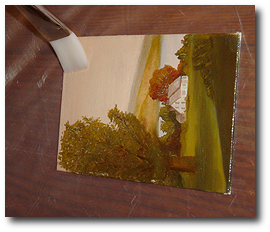
Rotate your painting so that you will be working in the horizontal plane. Without reloading your brush, start at one corner, straight across the canvas without stopping, and then brush back over your stroke in the opposite direction. Repeat this until you have gone over the entire painting. This step will help to distribute the Dammar more evenly across your canvas.
Step 11
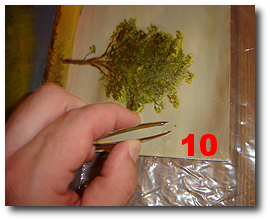
At any point during the application of the Dammar Varnish, you might find a piece of debris has fallen onto the canvas. Using the tweezers (item 10), gently remove the contaminant while trying not to disturb the varnish.
Step 12
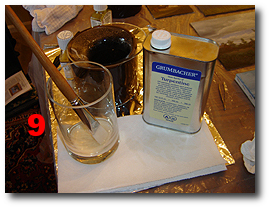
Once you have completed coating your painting with varnish, place your brush into a container (item 9) with turpentine. You want to keep the varnish from hardening onto your brush while you wait for the varnished paintings to dry enough to continue with the second and third coatings.
Step 13
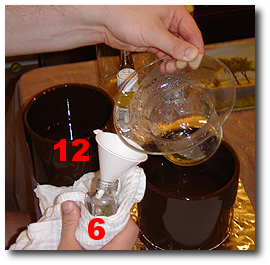
Varnish is reusable, so you should pour, using a funnel (item 12), whatever you have not used back into its original jar (item 6). I recommend doing this between varnish coats. Let the applied varnish dry for a minimum of two hours between coats. However, the time might vary depending on the temperature and humidity in your area. If the varnish is tacky to the touch, it’s not ready for a second or third coating. I test my varnish by pressing a finger along the edge of the canvas. If I see a fingerprint, it’s not ready. One source said you could wait a day between varnish coatings.
If you apply two or more coats of varnish, please start this tutorial from the beginning, working on each new coat of varnish as if it were the first. This would mean starting again at step 2.
Step 14
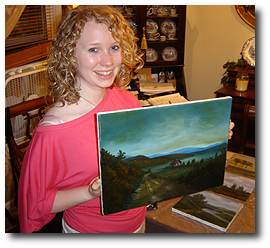
After about 10 minutes, the varnish should be tacky enough not to run or drip. Kate is here holding up the painting after she examines the varnish. Problem spots will be visible when looking across the surface of the canvas at eye level. Missed spots or uneven brush strokes will be visible. During this examination, you will decide if another coat of varnish is needed. “If needed, apply a second [or third coat] to fix rough areas after they dry. Do not try to fix areas by themselves, but apply a full second [or third coat] of the varnish.” [3] I have found that three coats of varnish give me the best results.
Concluding Thoughts
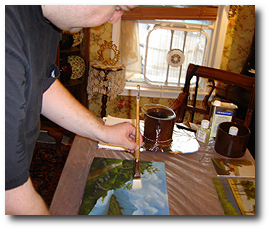
Here I am varnishing another painting. I like to have several oil paintings ready before I start a varnishing session. Applying two to three coats of varnish can take one to two days, so I like to have several paintings ready. As I finish varnishing one, I move it aside and start my second, third, and so on. I then let them all dry together. I hope you enjoyed this Winsor & Newton Dammar Varnish Tutorial by John O’Keefe Jr. & Kate (Nelson) O’Keefe.
Footnotes:
- Jamie Williams Grossman, www.wetcanvas.com, “How to Varnish an Oil Painting.”
- David Pyle, www.winsornewton.com, “The Last Layer: The Why, What, When, and How of Varnishing.”
- Jeff Beer, “How to Simply Varnish an Oil Painting.”
Excellent tutorial. Does the use of Turps rather than White Spirit make any difference? Can the varnish be used on an acrylic painting in the same way?
Honestly, I can’t answer your first question without researching it further. The Winsor & Newton Dammar that I used in this tutorial came premixed, and I used it straight out of the bottle as they made it.
Let me look into your question about the use of W&N Dammar on Acrylics and I’ll post a reply.
Hi Simon Painter,
Following is a quote taken directly from the Winsor & Newton website to answer your question about using W&N Dammar on acrylic paints: “All Winsor & Newton varnishes can be used on oil, alkyd, water mixable oil or acrylic paintings…”
One further note of W&N Dammar on acrylic paint. W&N makes a variety of Acrylic “tweaked” varnishes ranging from matt to gloss. I would recommend checking them out. I don’t use acrylics myself, so I do not have experience using those specific ones.
They have additional information on their website: https://www.winsornewton.com/